Portfolio Granularity and Demand Estimation
The effective statistical information contained in a portfolio is governed by its concentration structure, not the raw number of holdings. This has first-order implications for structural estimation.
Read the draft →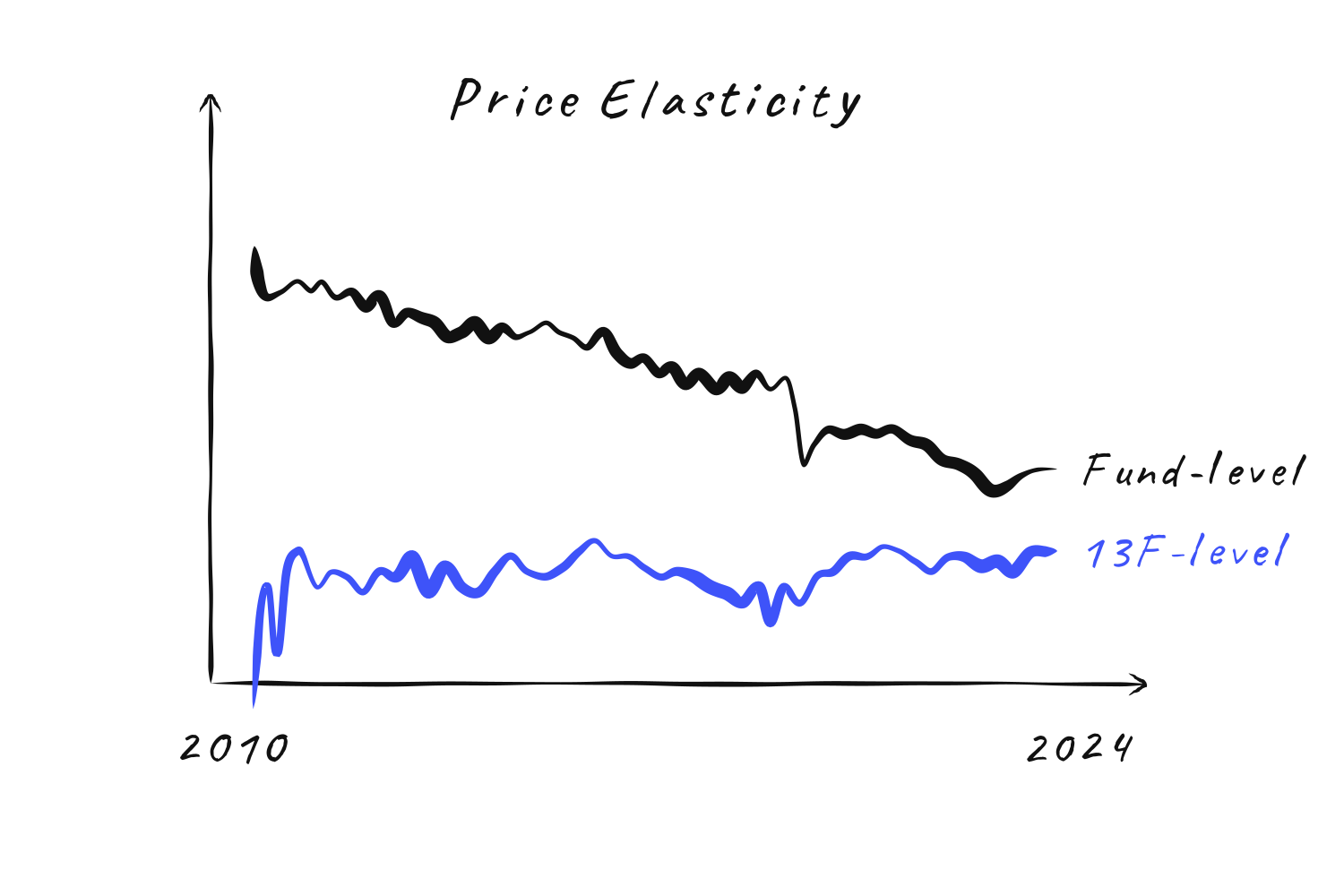
I am a fourth-year PhD candidate in Finance at INSEAD.
Before academia, I co-founded two companies: one failed miserably, and the other raised more venture capital than customers. Those experiences left me curious about how investors think, how capital gets allocated, and why a (my) company's brilliance or stupidity can look like noise next to the mighty hand of markets.
That led me to a period of quiet contemplation at an asset management firm, and eventually to pursuing a PhD.
I study questions somewhere between asset pricing, portfolio choice, and financial econometrics.
Portfolio Granularity and Demand Estimation
I show that the effective statistical information contained in a portfolio is governed by its concentration structure, not the raw number of holdings. Standard practice aggregating heterogeneous mandates into a single observed portfolio does not increase statistical power, but instead induces convexity. A granular estimator yields well-behaved, downward-sloping demand curves without imposing sign restrictions; its implied aggregate price elasticities are 2–4 times larger than previous estimates.